Code Evaluation
In this section we will explore CIDER's support for evaluation of Clojure code.
FYI
A semicolon character is used to indicate the start of comment text in Clojure. Any text that appears after a semicolon is ignored.
Open the file eval.clj located in the code/clj/cider-tour/src/cider-tour directory of the GitHub project:
Screenshot - eval.clj

Evaluating Expressions
Position the cursor (i.e. "point") at the end of the (range 1 6) statement and type C-x C-e:
Output

CIDER evaluates the range statement and displays the result as a temporary overlay within the buffer. The overlay is removed on any subsequent input to Emacs.
The keybinding C-x C-e executes the command cider-eval-last-sexp which evaluates the expression preceding point.
Now let's evaluate a more interesting expression. In the next line of code, position point immediately after the end of the (range 1 (inc 5)) expression and type C-x C-e.
Output

Note that only that range statement is evaluated because it is the expression that precedes point.
FYI
C-x C-eis useful when for evaluating nested expressions and inspecting the value of vars.
Now, without moving the cursor, type C-M-x:
Output
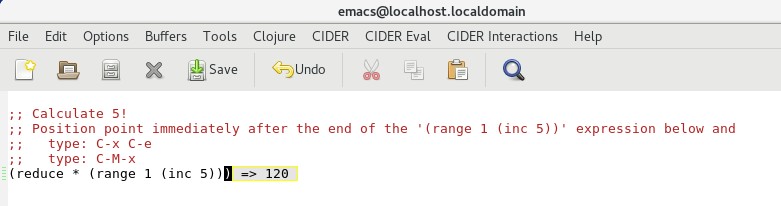
The keybinding C-M-x invokes the cider-eval-defun-at-point command which parses the expression at point to find the top-level expression and then evaluates the top-level expression. In this cause the top-level expression is the (reduce ...) function call.
FYI
C-M-xis useful for evaluating (or re-evaluating) top-level expressions such as var (def) and function (defn) definitions. As long as the point lies somewhere within the top-level expression, the top-level expression will be evaluated.
Now, position the cursor within the (defn my-factorial ...) expression and type C-M-x to evaluate the function definition:

The result of the evaluation is the association of the symbol my-factorial with a Clojure var that points to the function. CIDER displays the namespace-qualified symbol as the result.
Now let's evaluate the my-factorial function. Position point at the end of the (my-factorial 10) line and type C-x C-e:
Output

This evaluates the preceding expression.
Next, type the following:
C-c M-n
C-c M-p [RET]
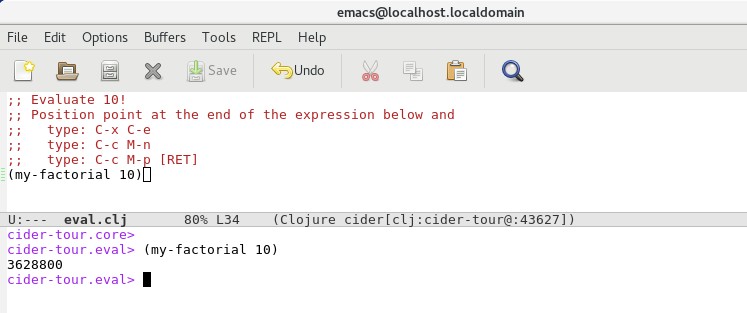
C-c M-n executes the CIDER function cider-repl-set-ns which changes the default namespace of the CIDER REPL buffer to the namespace of the Clojure eval.clj file:
REPL Output (1/2)

C-c M-p copies the expression preceding point in our eval.clj buffer to the REPL buffer. CIDER switches focus to the REPL buffer. Pressing [RET] evaluates the expression:
REPL Output (2/2)
FYI
The use of
C-c M-nto change the namespace in the REPL was necessary for two reasons:
- The function
my-factorialis defined in thecider-tour.evalnamespace and our default namespace in the CIDER REPL buffer was set tocider-tour.core(from our previous work incore.clj).- The symbol
my-factorialin the expression(my-factorial 10)is not namespace-qualified. The REPL assumes all symbols that are not namespace-qualified reside in the default namespace. Evaluation of the expression in the REPL buffer withcider-tour.coreas the default namespace would therefore fail.
Evaluating Code Blocks
Up to this point we have evaluated individual expressions. CIDER also provides support for evaluating code blocks (i.e. sequences of expressions): buffers, files and regions.
Switch back to the eval.clj buffer and type C-c C-k to evaluate the entire buffer:
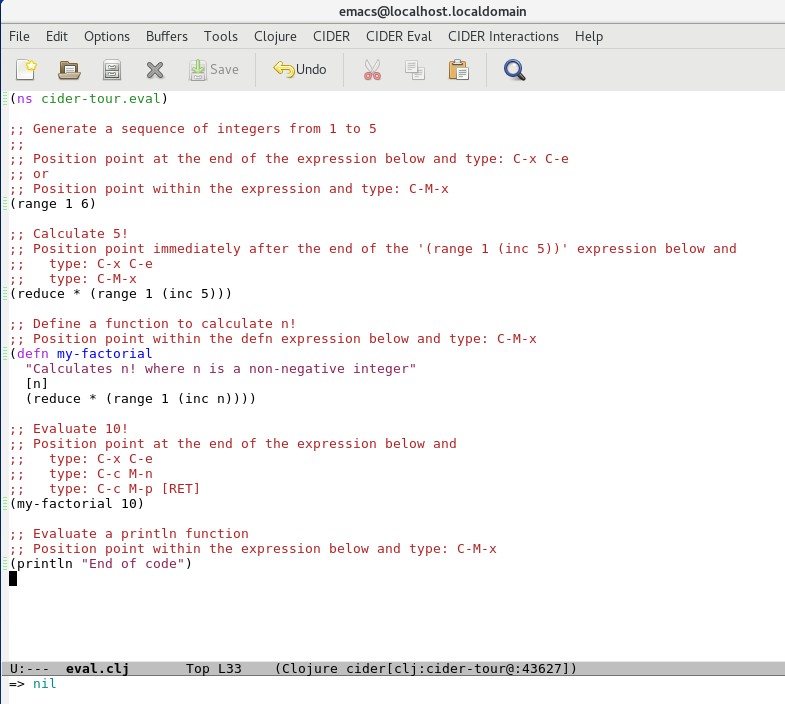
When the entire buffer is evaluated, CIDER displays the return value of the last expression in the minibuffer. The last expresssion in the buffer is (println ...) function call. println always returns nil so the result of evaluating the buffer is nil.
To evaluate a region select a region of expressions in a buffer and type C-c C-v C-r.
To load and evaluate a Clojure file type C-c C-l and provide the path to the file.
Summary
We explored the following commands for evaluating Clojure expressions in CIDER:
| Keybinding | Command | Summary |
|---|---|---|
| C-x C-e | cider-eval-last-sexp | Evaluate the expression preceeding point |
| C-M-x | cider-eval-defun-at-point | Evaluate the top-level expression containing point |
| C-c M-p | cider-insert-last-sexp-in-repl | Copies the expression preceding point to REPL buffer input line |
| C-c C-k | cider-load-buffer | Evaluates the current buffer |
| C-c C-l | cider-load-file | Loads the file into a new buffer and evaluates the buffer |
| C-c C-v C-r | cider-eval-region | Evaluates a selected region |
These commands are indispensable tools in the CIDER toolbox. The CIDER Eval menu provides the full set of available commands for code evaluation.